Solution to Kaggle's Dogs vs. Cats Challenge using Convolutional Neural Networks
Contents
Dogs vs. cats challenge [1] from Kaggle ended in Jan 2014 but it is still extremely popular for getting started in deep learning. This is because of two main reasons: the data set is small (25,000 images taking up about 600MB), and it is relatively easy to get a good score.
There are many many online articles discussing on how pre-process data , design a CNN model and finally train the model. So, in this post I am not going to discuss the implementation details. Instead, I am simply going to report my results using a custom designed model and transfer learning. I used Tensorflow and tf.keras with Python and it is available from my Exploring Deep Learning repository [2] at Github.
Learning using a Custom Model
Note that this is my best attempt and not the first attempt. I used four blocks of 2D convolution layers followed by max pooling. In the end, I used two dense layers and a softmax layer as output. I also used dropout layers and image augmentation. The exact command line for training this model is:
TrainCNN.py --cnnArch Custom --classMode Categorical --optimizer Adam --learningRate 0.0001 --imageSize 224 --numEpochs 30 --batchSize 16 --dropout --augmentation --augMultiplier 3The CNN model is given below:
---------------------------------------------------------------
Model: "Custom"
---------------------------------------------------------------
Layer (type)                 Output Shape              Param #

conv2d (Conv2D)              (None, 224, 224, 32)      896
max_pooling2d (MaxPooling2D) (None, 112, 112, 32)      0

conv2d_1 (Conv2D)            (None, 112, 112, 64)      18496
max_pooling2d_1 (MaxPooling2 (None, 56, 56, 64)        0

conv2d_2 (Conv2D)            (None, 56, 56, 128)       73856
max_pooling2d_2 (MaxPooling2 (None, 28, 28, 128)       0

conv2d_3 (Conv2D)            (None, 28, 28, 256)       295168
max_pooling2d_3 (MaxPooling2 (None, 14, 14, 256)       0

flatten (Flatten)            (None, 50176)             0
dense (Dense)                (None, 512)               25690624
dense_1 (Dense)              (None, 256)               131328
dense_2 (Dense)              (None, 2)                 514
===============================================================
Total params: 26,210,882
Trainable params: 26,210,882
Non-trainable params: 0
---------------------------------------------------------------
The above model was trained on 15,000 (7,500 each for dogs and cats) randomly chosen images from the Kaggle data set and validated with a separate 5,000 (2,500 each for dogs and cats) images. The model achieved 94% accuracy after 24 epochs. It took about 4 hours of training on my PC with NVidia GeForce GTX 1050 with 2GB of RAM.
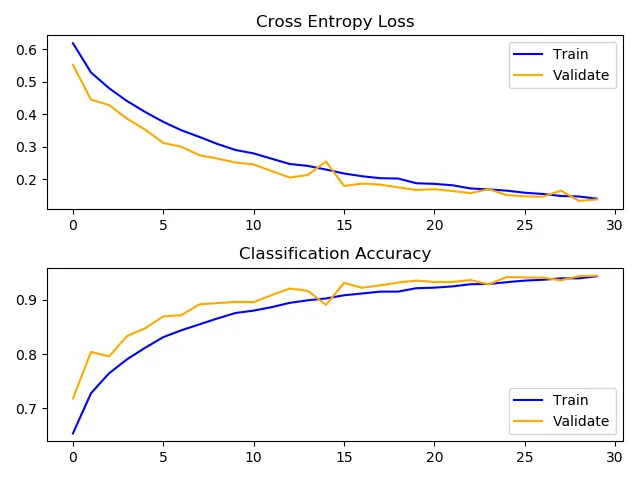
Cross-entropy loss for training and validation and the classification
accuracy for training and validation using a custom CNN model.
Transfer Learning using VGG16 Model
For the second part, I used the VGG16 model with imagenet weights without the top layer and a custom denser layers at the end. Similar to the previous step, I used dropout layers and image augmentation. The exact command line for training this model is:
TrainCNN.py --cnnArch VGG16 --classMode Categorical --optimizer Adam --learningRate 1e-5 --imageSize 224 --numEpochs 30 --batchSize 25 --dropout --augmentation --augMultiplier 3The CNN model is given below:
---------------------------------------------------------------
Model: "VGG16"
---------------------------------------------------------------
Layer (type)                 Output Shape              Param #
===============================================================
vgg16 (Model)                (None, 7, 7, 512)         14714688
flatten (Flatten)            (None, 25088)             0
dense (Dense)                (None, 512)               12845568
dense_1 (Dense)              (None, 256)               131328
dense_3 (Dense)              (None, 2)                 514
===============================================================
Total params: 27,692,104
Trainable params: 12,977,410
Non-trainable params: 14,714,688
---------------------------------------------------------------
The above model was trained on the same dataset as the custom model above and it achieved an accuracy of 98% after 11 epochs. Clearly, this model is far more efficient and more accurate then the custom designed model.
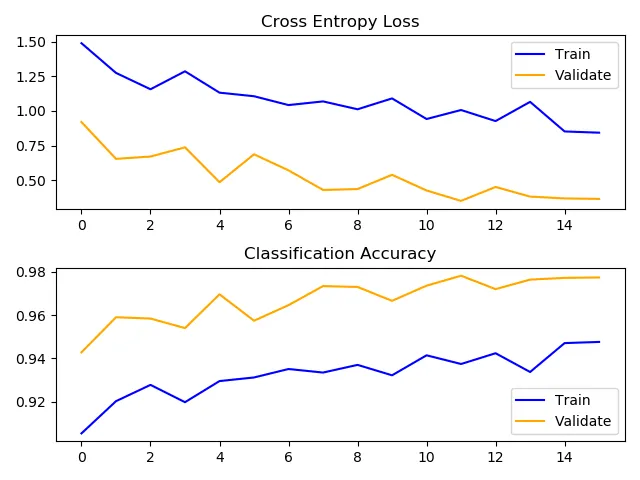
Cross-entropy loss for training and validation and the classification accuracy
for training and validation using a transfer learning from VGG16 model.